Register

Compare the Storage Classes

Same platform, same S3 API. Each Class balances storage price, retrieval cost, and minimum duration for a different access pattern.

Standard
Live
Archival Storage
Temporary Price Program, active on request
Warm Storage
Planned early 2027
Cold Storage
Planned early 2027
Storage price /GiB/hour €0.00002750
≈ €0.0184 /GB/mo
€0.00000626
≈ €0.0042 /GB/mo
€0.00001689
≈ €0.0113 /GB/mo
€0.00000626
≈ €0.0042 /GB/mo
vs Standard baseline −77% −39% −77%
Retrieval Free Free €0.00901 per GiB retrieved €0.02702 per GiB retrieved
Minimum duration None None 30 days 90 days
Minimum commitment None 10 TB per bucket None None
Egress traffic Standard rates Standard rates Standard rates Standard rates
Availability SLA 99.95% 99.85% 99.9% 99.85%
Object lock & retention Yes No Yes Yes
Best for Hot data, frequently accessed workloads Cold archives, ahead of the Classes launch Infrequent access: backups, logs, DR Cold archive, long-term retention
  1. [1]

    Volume tiers (512 TiB / 1 PiB) apply to the Standard Class only. No volume tiers or additional discounts apply on Archival Storage (Temporary Price Program), Warm Storage, or Cold Storage. Monthly prices are rounded approximations; billing is per GiB/hour.

  2. [2]

    Retrieval is a one-time fee per GiB of data retrieved, not a recurring per-hour rate. Retrieval fees and minimum storage durations apply to the Warm and Cold Storage Classes from their launch.

The Storage Classes roadmap

1

Today: Archival Storage (Temporary Price Program) live

All Object Storage data is currently stored and billed on the Standard Class. For archival needs, the Archival Storage (Temporary Price Program) already applies the future Cold Storage rate, on request.

2

Early 2027: Warm & Cold Storage launch

Warm Storage covers infrequent access: backups, logs, and disaster recovery. Cold Storage covers long-term archiving. Retrieval fees and minimum durations apply from day one.

3

Transition: 30-day window

After launch, a 30-day window allows migrating each bucket to the preferred Storage Class. Past the deadline, the Archival Storage (Temporary Price Program) discount stops and Standard Class pricing applies.

Archival Storage (Temporary Price Program): early access to Cold Storage pricing


The Warm and Cold Storage Classes arrive in early 2027. Until then, Archival Storage (Temporary Price Program) applies the future Cold Storage rate to approved archival buckets, lowering data archiving costs without waiting.

Nothing changes for existing applications: same buckets, same S3 API, same European zone. Once a request is accepted, usage is billed at the Standard rate, and the difference down to the Archival Storage (Temporary Price Program) rate is reflected as a monthly discount on the invoice for the next billing period.

Cold Storage pricing vs AWS S3 Glacier, Wasabi, Hetzner & Backblaze

Exoscale Storage Classes are priced to compete with global and European providers, with EU data residency included by design.

Exoscale Cold Storage & Archival Storage (Temporary Price Program)
€0.0042
AWS S3 Glacier Instant Retrieval
€0.0043
Hetzner Object Storage
€0.0049
Wasabi
€0.0059
Backblaze B2
€0.0060
Exoscale Warm Storage
€0.0113
AWS S3 Standard-IA
€0.0117
Infomaniak
€0.0117
OVHcloud S3 Standard
€0.0119
Scaleway
€0.0150
IONOS
€0.0150
DigitalOcean
€0.0161
Exoscale Standard Storage
€0.0184
AWS S3 Standard
€0.0212
  1. [1]

    What these figures show: storage price only, per GB/month, rounded, as observed in June 2026.

  2. [2]

    What they exclude: retrieval fees, egress traffic, API requests, and minimum duration or commitment terms. These vary by provider and can change the total cost significantly.

  3. [3]

    Redundancy is not directly comparable: some list prices reflect single availability zone (single-AZ) storage, while others replicate data across multiple zones (multi-AZ) for higher durability and availability. More resilient storage generally costs more, so weigh the redundancy model alongside the price, not the price alone.

  4. [4]

    Always check each provider’s current pricing and terms before deciding.

Archive with confidence on European infrastructure

Our team reviews every request and helps select the right Class for archives, backups, and compliance data. The activation form takes a few minutes.

Request activation

Archival Storage (Temporary Price Program) requirements

Activation is reviewed case by case and reserved for genuine archival needs. It is not a new default price.

10 TB minimum storage commitment

10 TB Minimum Commitment

Each enrolled bucket is billed for at least 10 TB of storage on Archival Storage (Temporary Price Program), even if it holds less data.

Archival workloads only

Archival Workloads Only

Cold archives, long-term backups, and retention data. Hot, frequently accessed data stays on the Standard Class.

No object lock or retention

No Object Lock or Retention

These features are not available on Temporary buckets. Workloads requiring immutability guarantees should remain on the Standard Class.

How to activate Archival Storage (Temporary Price Program)

1

Submit a request

Fill in the activation request form below with the organization name and the list of buckets to enroll.

2

Review & confirmation

The Exoscale team checks each bucket against the program requirements and confirms the activation.

3

Monthly discount

Once approved, nothing else is required: the discount starts with the next full billing period and appears on that month's invoice.

Activation request form

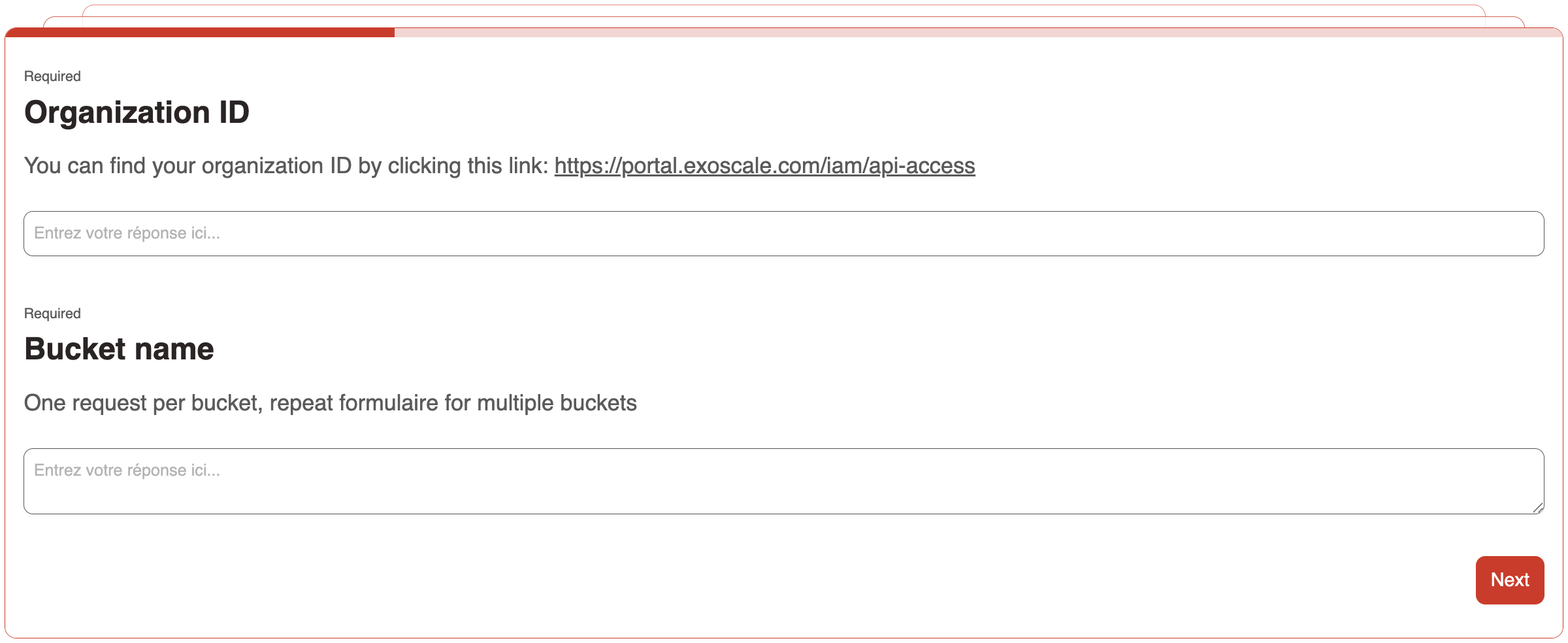
Fill in the form below with the organization name and bucket name to enroll. One request per bucket. Each request is reviewed against the program requirements before activation. It takes less than 3 minutes.

Form not loading? Open the form in a new tab.

Frequently asked questions about Object Storage Classes

What is a Storage Class in object storage?

A Storage Class defines how objects are stored and billed within the same bucket infrastructure. Each Class trades storage price against retrieval cost, minimum storage duration, and availability SLA, so rarely accessed data can cost much less than hot data. A single S3-compatible API covers all Classes.

What are the four Object Storage Classes?

The four Classes on Simple Object Storage are Standard, Archival Storage (Temporary Price Program), Warm Storage, and Cold Storage. Standard is live today and stores hot, frequently accessed data. Archival Storage (Temporary Price Program) is available now, on request, for archival workloads. Warm and Cold Storage are planned for early 2027: Warm Storage targets infrequently accessed data such as backups and logs, while Cold Storage targets long-term archives.

Which is the cheapest Storage Class?

Archival Storage (Temporary Price Program) and the future Cold Storage Class share the lowest rate: €0.0042 per GB/month, 77% below Standard. Until the Cold Storage Class launches, Archival Storage (Temporary Price Program) applies that rate to approved archival buckets.

What is the cheapest S3-compatible archival storage option?

At €0.0042 per GB/month, Archival Storage (Temporary Price Program) and the future Cold Storage Class rank among the cheapest S3-compatible archival storage options in Europe, below the rounded public list prices of AWS S3 Glacier Instant Retrieval, Hetzner, Wasabi, and Backblaze B2 (see the comparison above).

What is Archival Storage (Temporary Price Program)?

A pricing program that applies the future Cold Storage rate to approved archival buckets before the production Classes launch. Activation is on request, and the rate difference comes back as a monthly discount on the invoice, starting with the next billing period. Compared to Standard, the availability SLA is 99.85% instead of 99.95%, and object lock and retention are not available.

Who is eligible for Archival Storage (Temporary Price Program)?

Organizations with genuine archival needs: cold archives, long-term backups, and retention data. Each enrolled bucket carries a 10 TB minimum storage commitment: storage is billed for at least 10 TB, even if the bucket holds less. Requests are reviewed individually, and hot workloads stay on the Standard Class.

What happens when the Warm and Cold Storage Classes launch?

From launch, planned for early 2027, retrieval fees and minimum storage durations apply, as shown in the comparison table above. A 30-day migration window then allows moving each bucket to the preferred Storage Class. Past the deadline, the Archival Storage (Temporary Price Program) discount stops and Standard Class pricing applies.

How is the discount applied to my invoice?

Usage is billed at the Standard rate, and the difference down to the Archival Storage (Temporary Price Program) rate comes back as a monthly discount on the invoice. Billing accrues at the end of each month, and the discount starts with the next full billing period. For example: a request approved on June 20th covers July usage, and the discount appears on the July invoice, issued at the end of that month. Once approved, nothing else is required.
Do egress and network fees change between Storage Classes?

No. Egress traffic is billed at standard rates on every Storage Class, and inbound traffic stays free. Retrieval fees are a separate, per-GB charge that only applies to the Warm and Cold Storage Classes once they launch; the Standard Class and Archival Storage (Temporary Price Program) have none.

Is this a European alternative to Amazon S3 Glacier?

Yes. Like S3 Glacier, the Cold Storage Class and Archival Storage (Temporary Price Program) target long-term data archiving at cold storage prices, through a fully S3-compatible API. The difference: data stays in the selected European zone, on GDPR-compliant, ISO 27001-certified infrastructure, outside the reach of non-European jurisdictions.