Self-Hosted LLMs: Benefits, Drawbacks, and Infrastructure
Self-Hosted LLMs: Benefits, Drawbacks, and the Right Infrastructure Choice
As more AI initiatives move into production, organizations are rethinking how to operate them securely and efficiently with self-hosted LLMs. Running models on their own infrastructure allows teams to define deployment environments, access controls, update cycles, and integrations according to their requirements. However, with self-hosting, the organization is responsible for keeping the model reliable and available in production.
In this article, we explain what self-hosted LLMs are and where they create value. We also look at where they add complexity and why the infrastructure choice has a direct impact on success.
Quick summary of this article
- Self-hosting can be a good fit when data must stay within a defined environment or when external platforms do not meet an organization’s technical requirements.
- It also means that the organization is responsible for keeping the model available, secure, and reliable in production.
- Whether self-hosting saves money depends on the total cost of infrastructure, maintenance, and internal staff, as well as how regularly the system is used.
- A cloud-based setup can reduce the work involved in managing GPUs and platform operations while still allowing the organization to host the model in its own environment.
What Is a Self-Hosted LLM?
A self-hosted LLM is a large language model that an organization deploys and manages on infrastructure it controls, rather than relying solely on a third-party API like OpenAI or Anthropic. In practice, that means the company decides where the model runs, how it is configured, and how it is scaled. Typical environments include GPU instances, private cloud environments, dedicated cloud infrastructure, and on-premises servers.
The Advantages of a Self-Hosted Large Language Model
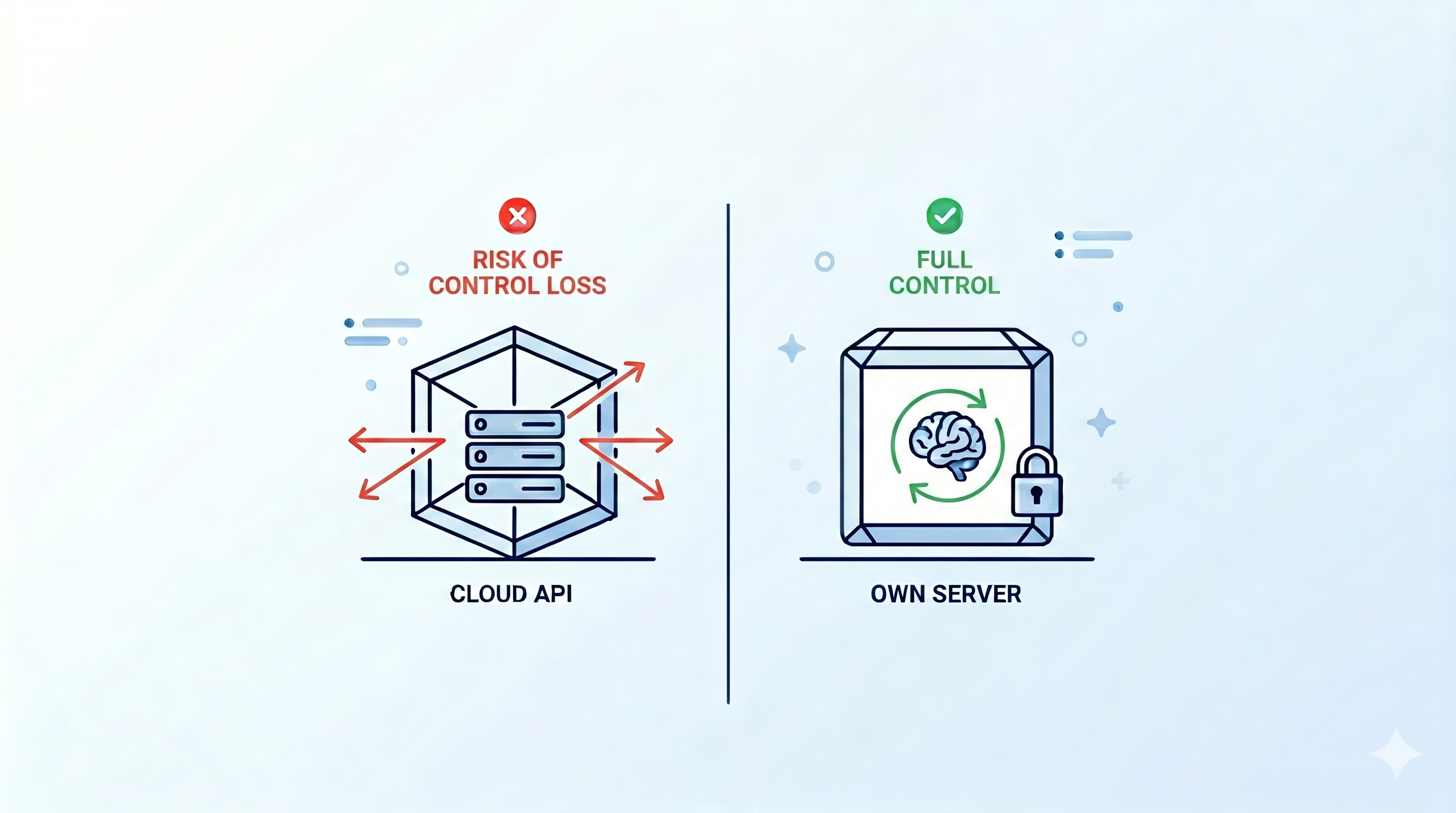
Organizations usually choose a self-hosted LLM when external platforms do not fit their regulatory or technical requirements. The aim is to operate AI on terms that match the organization’s existing systems and responsibilities.
- Data control: With a self-hosted large language model, organizations retain control over where sensitive information is stored and processed. Data does not need to be transferred to an external AI provider.
- Privacy and compliance: Self-hosted LLMs can help organizations align deployments with regulatory, legal, and industry-specific requirements. This is especially relevant for teams working with customer records, financial information, healthcare data, or other sensitive content.
- Customization and tuning: Hosting the model internally allows teams to fine-tune it with internal documents or product knowledge and adjust elements such as output formats and model parameters. This can improve output relevance for specialized use cases.
- Performance and availability control: Hosting an LLM on infrastructure that the organization controls enables more direct decisions around latency, throughput, scaling, and uptime. It can also reduce dependence on external rate limits, shared resources, or platform-level policy changes.
- Reduced noisy-neighbor risk: Running a self-hosted LLM on dedicated infrastructure can mitigate noisy-neighbor effects common in shared environments. That can support more consistent performance for latency-sensitive or high-throughput workloads. Dedicated deployments are generally more predictable because resources are not shared in the same way as multi-tenant services.
- Autonomy and independence: A self-hosted large language model reduces dependence on an external provider’s model roadmap and service decisions. That means there is no risk of a hosted API model being deprecated or withdrawn by the provider, which can be important for long-lived internal systems and production workflows.
- Cost efficiency for high-volume scenarios: Self-hosting can reduce costs when an organization processes a large and steady number of requests. Whether it is cheaper than a managed API depends on the model, and the infrastructure costs.
Taken together, these benefits explain why a self-hosted large language model is often attractive to organizations with stricter requirements or more mature AI workloads. The value is not limited to technical control alone. In many cases, it also supports stronger internal ownership, clearer operational boundaries, and a setup that is easier to align with long-term business priorities.
The Drawbacks of Self-Hosting an LLM
Most drawbacks stem from the work required to operate the model reliably in production. The table below summarizes the most common challenges when self-hosting an LLM.
- Infrastructure complexity: With self-hosting, teams must build and operate the production environment themselves, including serving the model and maintaining the systems required to process requests reliably.
- GPU provisioning and maintenance: Production deployments often rely on powerful GPU infrastructure, which can introduce provisioning delays, quota constraints, and ongoing setup and maintenance work. That overhead becomes more visible once workloads move beyond testing and into regular use.
- Scaling and reliability: Operating a self-hosted LLM in an organization-controlled environment also means owning observability, alerting, failover planning, and performance tracking. In practice, that includes monitoring inference behavior and maintaining service levels as usage changes.
- Longer deployment cycles: A model that works in a local test still needs to be validated under production load and prepared for failures. Since the organization manages this process itself, new model versions and configuration changes may take longer to release than with a managed API.
- Internal expertise requirements: Teams need people who can operate the model-serving environment and troubleshoot issues in production. Otherwise external support is required.
These trade-offs show that a self-hosted large language model comes with direct operational implications, affecting staffing, scalability, delivery speed, and day-to-day ownership. For organizations considering this approach, the key question is often whether the team is ready to support everything that comes with it.
Benefits and Trade-Offs of Self-Hosted LLMs at a Glance
The table below summarizes the main benefits and trade-offs of self-hosted LLMs at a glance.
| Aspect | Key Advantage | Main Trade-Off |
|---|---|---|
| Data handling | Sensitive data remains within the organization’s own infrastructure | The organization must manage security, access controls, and compliance internally |
| Customization | The model can be adapted to handle domain-specific terminology, exceptions, and handoffs to human reviewers | Adaptations need regular evaluation to ensure consistent results |
| Performance | Direct influence over latency, throughput, and availability | Monitoring, scaling, and reliability must be actively managed |
| Cost | Infrastructure costs can be easier to predict than usage-based API fees | Organization still pay for available computing capacity when demand is low |
| Operations | Clear ownership of the deployment environment | Organizations are responsible for resolving incidents and restoring service |
Is a Self-Hosted LLM More Cost-Effective?
Managed APIs are often cheaper and easier for initial testing because teams do not need to set up their own infrastructure. Self-hosting can become cheaper when usage is high and steady enough to make good use of the available computing power.
However, the total cost includes more than hardware or cloud resources. Organizations also need to pay for maintenance and the employees who operate the system. Self-hosting is therefore not automatically the cheaper option.
Why Infrastructure Choice Matters for Self-Hosted LLMs
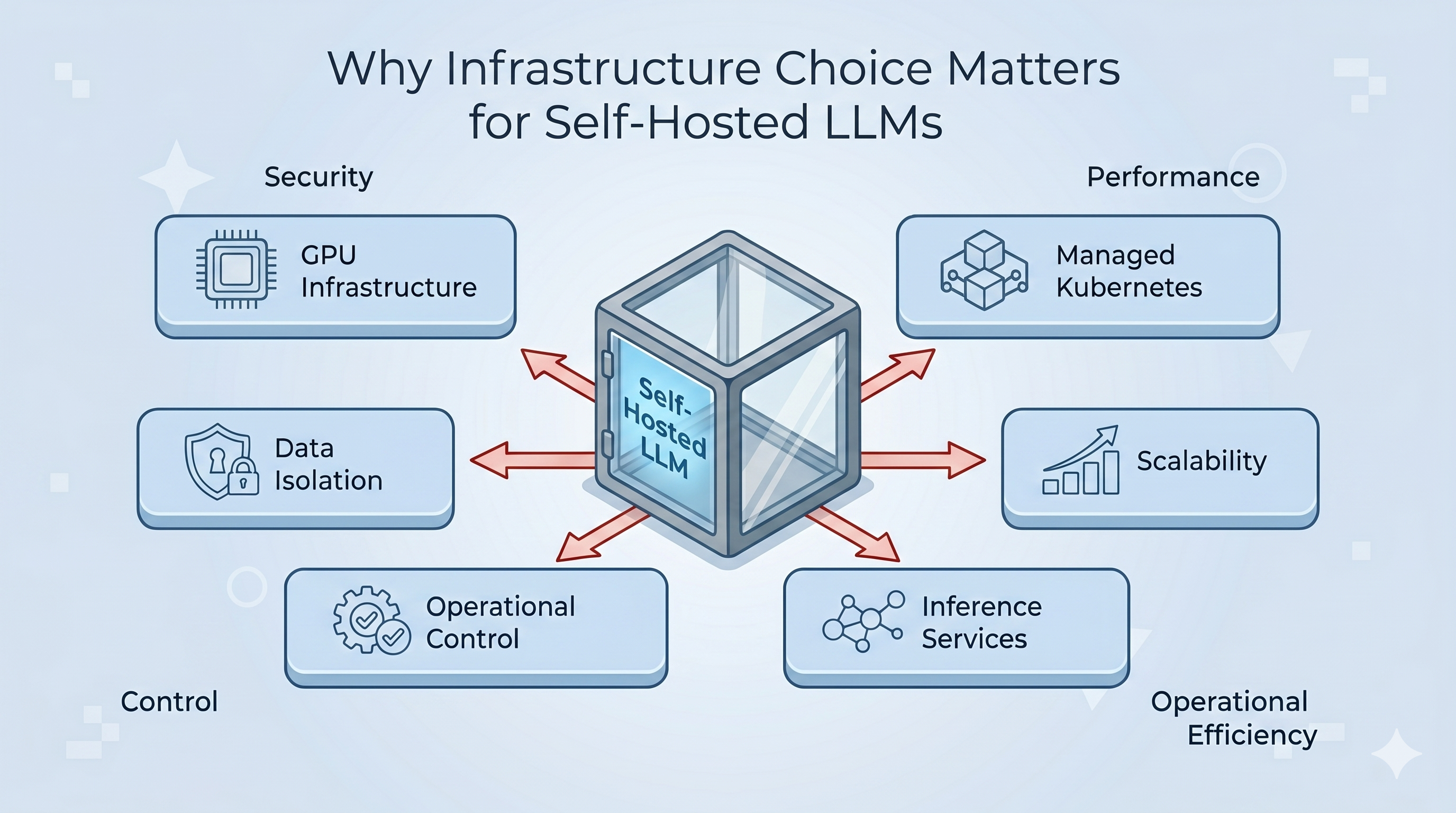
Infrastructure plays a central role in how well a self-hosted LLM performs in practice. It influences data isolation, reliability, scalability, and the amount of operational effort required to support the workload over time. Two organizations may choose the same model and still end up with very different outcomes depending on the environment behind it.
As a result, many organizations are not looking for a fully DIY setup. In practice, teams want complete ownership of the model, control over where data is processed and stored, and control over the deployment environment. At the same time, most organizations do not want to manage GPU provisioning, Kubernetes operations, autoscaling, monitoring, and the day-to-day work required to keep the system stable entirely in-house.
Conclusion: A Practical Path to Self-Hosted LLMs
A self-hosted LLM can be a practical choice when data must remain within a defined infrastructure or when response times need to remain predictable under production load. For many teams, cloud infrastructure is a more practical path than a fully DIY approach. In that context, Exoscale can be a relevant option for organizations that prioritize European data locality and AI-ready cloud infrastructure services. In that kind of self-hosted deployment, GPU infrastructure, managed Kubernetes, and dedicated inference services can help reduce operational complexity while preserving more control over the deployment environment.
FAQ about Self-Hosted Large Language Models
How does a self-hosted LLM differ from a managed API?
Organizations often choose this approach when models must run in isolated environments, the inference stack needs to be fully auditable, or a validated model version must remain unchanged. Self-hosting an LLM can also support applications in locations with limited or unreliable external connectivity.
Why would a company choose a self-hosted large language model?
A company may choose a self-hosted LLM to operate the model as part of its own technology stack rather than rely on an external API provider. This allows the organization to manage availability and model updates according to its own operational requirements.
Do self-hosted LLMs always require a fully DIY setup?
No. Many organizations use cloud infrastructure to run self-hosted LLMs without building every layer from scratch. That can make deployments easier to scale and manage while still preserving more control.
Are self-hosted LLMs more secure?
They can be, especially when organizations need tighter control over where data is processed and stored. However, security also depends on how well the deployment is designed, operated, and maintained.
Is a self-hosted LLM more cost-effective than a managed API?
Not automatically. Companies need to compare API fees with the full cost of infrastructure, maintenance, and internal staff. Self-hosting only becomes cheaper when these costs are spread across enough regular usage.

