MCP explained: What Is the Model Context Protocol?
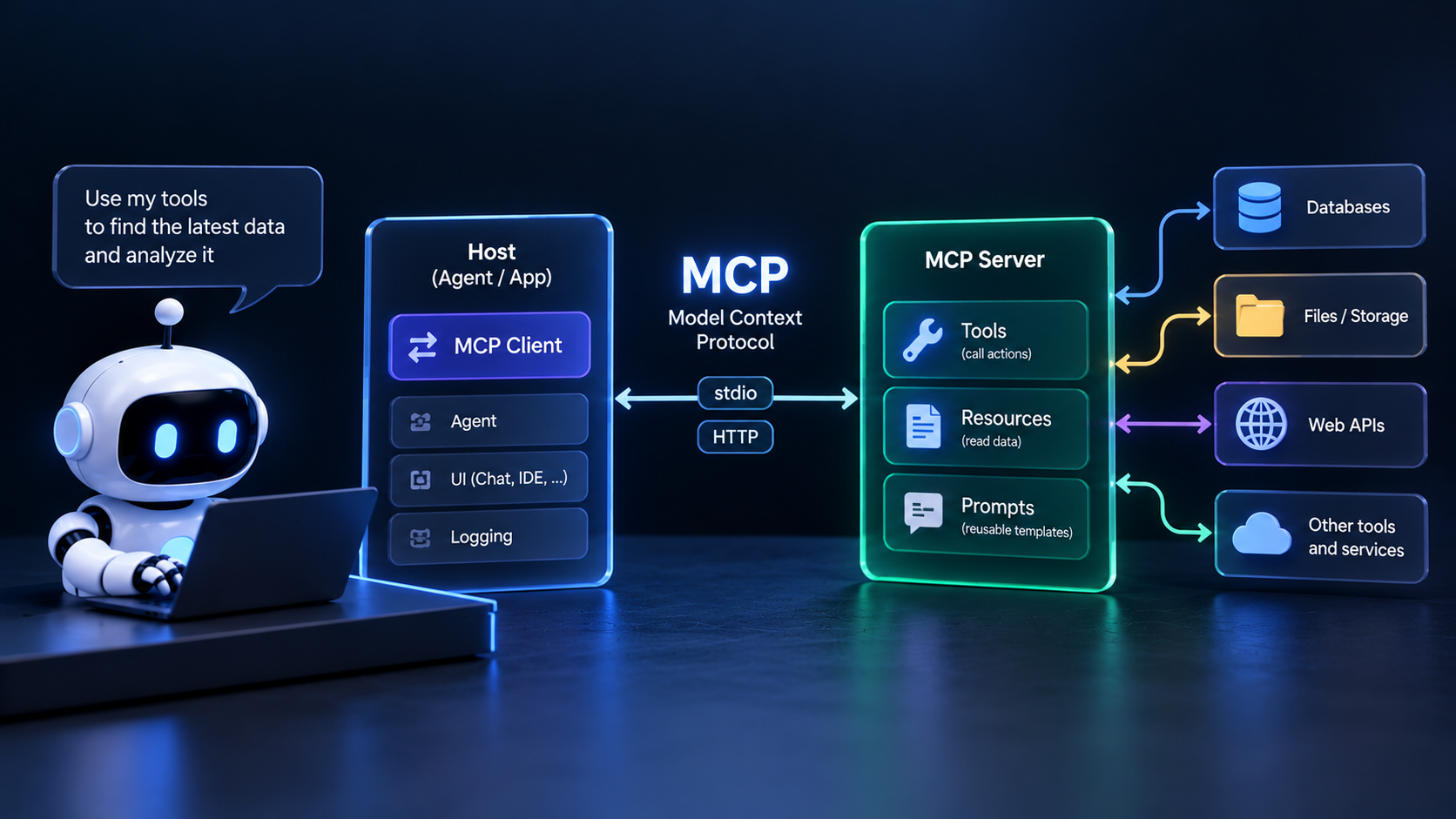
The Model Context Protocol, short MCP, is now one of the standard ways AI applications reach into customer data, which makes it worth being precise about what the protocol is and where each piece belongs. This is especially true for European teams, where the placement of each MCP component carries GDPR and CLOUD Act consequences. At Exoscale, the Swiss-headquartered sovereign European cloud, this comes up constantly with teams that need their data to actually stay in Europe.
Quick summary of this article
- The Model Context Protocol (MCP) is an open specification that lets AI applications call external tools, read external data, and load reusable prompts through a common wire format.
- MCP has three primitives (tools, resources, prompts), two transports (stdio and streamable HTTP), and a three-node topology (host, client, server).
- For European teams, the real question isn't whether to use the Model Context Protocol. It's which parts of an MCP deployment need to sit on EU-jurisdictional infrastructure to keep GDPR and CLOUD Act exposure under control.
- Three components carry personal data and must run on an EU-headquartered provider, which are the MCP server, the inference endpoint, and the host or agent runtime that connects to both of them, plus any logging it captures along the way.
- Hosted in an EU region of a US company doesn't satisfy the CLOUD Act analysis. An European cloud provider like Exoscale does.
Exoscale runs infrastructure for European teams that need their data to actually stay in Europe, not “hosted in an EU region of a US company,” which is a different thing. Exoscale is headquartered in Lausanne, Switzerland, operates data centers in Switzerland, Austria, Germany, Bulgaria, and Croatia, and sits outside US CLOUD Act jurisdiction.
What is the Model Context Protocol (MCP)?
The Model Context Protocol (MCP) is an open specification that lets AI applications call external tools, read external data, and load reusable prompts through a common wire format. MCP was released by Anthropic in November 2024 and donated to the Linux Foundation’s Agentic AI Foundation in December 2025. The wire format is JSON-RPC 2.0. That’s the whole protocol at the transport layer: structured request/response messages over a defined channel, nothing exotic.
The MCP topology has three nodes:
- Host: the AI application the user interacts with. Claude Desktop, Cursor, Zed and Goose are all MCP hosts.
- Client: Model Context Protocol plumbing embedded inside the host. One client per server. You don’t write clients by hand for the common cases; the host manages them.
- Server: a separate process that exposes capabilities to the host through the client.
A host can hold many clients, one per connected server. When we say “add an MCP server to Claude Desktop,” what actually happens is that Claude Desktop spawns (or connects to) a server process and instantiates a client to talk to it.
What are the three MCP primitives?
During the capability handshake, each Model Context Protocol server declares what it exposes. There are three primitive kinds, and the distinction between them is what most people get wrong on first read.
Tools are model-controlled actions. The LLM decides when to call them. A tool description is passed to the model, and the model chooses whether to invoke it, for example calling a REST API to create a ticket, or running a database query. Tools are what most people mean when they say “MCP.” They have the broadest client support today.
Prompts are user-controlled reusable workflow templates. A human explicitly picks one, from a slash-menu, a shortcut, or a prompt library. Prompts aren’t chosen by the model or auto-injected by the host.
Resources are application-controlled read-only data. The host decides which resources to inject into the context: files, database schemas, log excerpts. The model doesn’t request them; the application does. Resource support is the least mature of the three across clients, which is useful to know before you design around it.
All three primitives are declared via JSON Schema during the capability handshake, so the host knows exactly what the server offers before any call is made.
What are the two MCP transports?
The Model Context Protocol defines two transports, and the choice between them is mostly a deployment question.
stdio. The MCP server runs as a subprocess of the client. The client writes JSON-RPC to the server’s stdin and reads from its stdout. This is the local-integration path: a CLI-style server on the same machine as the host, no network involved. Almost all “install this MCP server locally” flows use stdio.
Streamable HTTP. Introduced in the March 2025 spec revision (replacing the deprecated HTTP+SSE transport), streamable HTTP puts the MCP server behind a single HTTP endpoint. The client POSTs JSON-RPC to it; the server responds with either
application/jsonor atext/event-streamwhen it needs to stream. The July 2026 revision made streamable HTTP fully stateless.
| Transport | Where server runs | Network required | Use case |
|---|---|---|---|
| stdio | Subprocess on same machine as host | No | Local developer integrations |
| Streamable HTTP | Independent process, any location | Yes | Remote/cloud-hosted servers, production deployments |
For anything running on shared infrastructure or across a network, streamable HTTP is the transport that matters. stdio only makes sense when host and server share a machine.
How big is the MCP ecosystem?
Anthropic launched the Model Context Protocol with a handful of reference servers in November 2024. By December 2025, the ecosystem had crossed 10,000 public servers, and counts across major registries continued to grow through mid-2026.
The official Python and TypeScript SDKs pulled in over 97 million downloads a month as of December 2025, with the TypeScript SDK alone exceeding 176 million monthly npm downloads by July 2026. OpenAI adopted MCP in March 2025, and Google DeepMind followed in April 2025, which is what tipped the Model Context Protocol from an Anthropic standard into an industry one.
The MCP ecosystem is large enough that “should we support MCP?” is no longer the question. The question is which servers to trust and where to run them.
What are the main MCP security risks of the Model Context Protocol?
MCP introduces attack classes that don’t show up in a normal REST integration:
- Tool poisoning: malicious instructions live in the tool metadata itself. The user doesn’t see it; the LLM parses it. Microsoft’s security team has flagged tool descriptions as a covert instruction channel.
- Indirect prompt injection: external data pulled in by an MCP tool contains instructions that steer the model into unintended actions.
- Rug-pull attacks: a tool definition mutates after the user has approved it.
- OAuth token interception. Session hijacking against the Model Context Protocol servers that broker access to third-party APIs.
- Cross-tool contamination: a compromised MCP server influences other servers through shared conversational context.
None of these are theoretical. They follow directly from how the Model Context Protocol works: tool metadata is untrusted input that reaches the model, and tools can share a session. Every MCP deployment needs a review of at least these five.
How do GDPR and the CLOUD Act apply to MCP deployments?
This is where the topology of the Model Context Protocol matters legally, not just architecturally.
Every MCP tool call that retrieves EU personal data is a GDPR processing event. If that call, or any intermediate hop, touches infrastructure operated by a company subject to US jurisdiction, GDPR Articles 44 through 49 on cross-border transfer come into play.
The CLOUD Act (2018) lets US authorities compel disclosure from any provider subject to US jurisdiction, including non-US companies with sufficient US nexus, such as US operations, employees, or parent entities subject to US law, regardless of where the data physically sits. An “EU region” of a US cloud is operated by a US-jurisdiction entity.
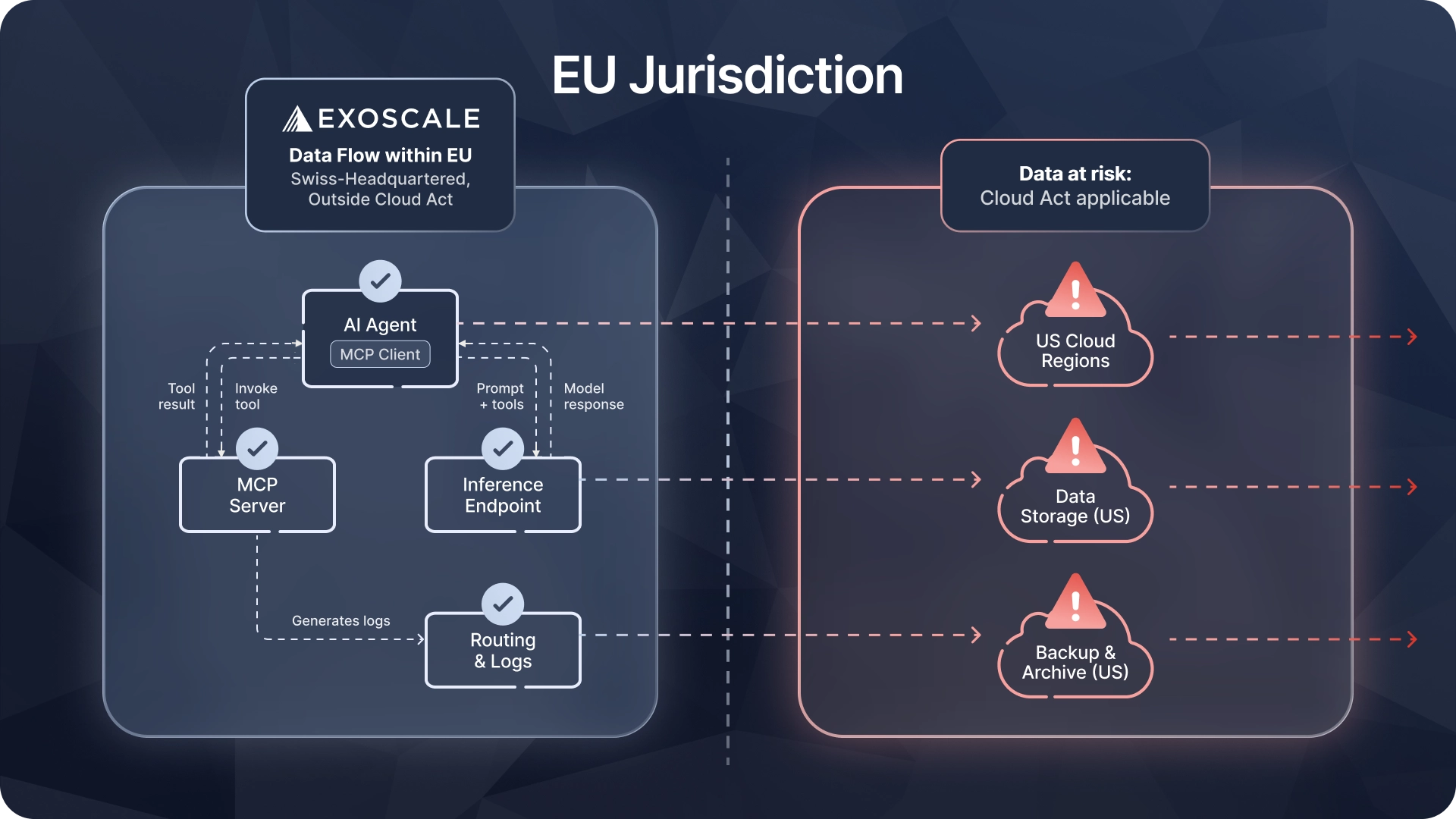
The European Data Protection Board (EDPB) and European Data Protection Supervisor (EDPS), in their joint response on the CLOUD Act, assessed that disclosure orders reaching EU-stored data would require a valid GDPR Article 49 (or Article 48) legal basis for the transfer, which in most commercial cases doesn’t exist. For a more detailed explanation, read our guide on CLOUD Act vs. GDPR. For a sovereign MCP deployment, three pieces need to sit inside EU-jurisdictional infrastructure, not merely inside an EU region:
- The MCP server exposing the tools.
- The inference endpoint the host calls.
- Any intermediate routing or logging between them.
Miss any of those and the sovereignty claim doesn’t hold.
Which European cloud providers are exempt from the US CLOUD Act?
The CLOUD Act reaches any operator headquartered in the United States, regardless of where the data physically sits. Providers exempt from it are the ones headquartered and incorporated outside US jurisdiction, a distinction that determines which cloud providers can credibly claim EU data sovereignty in the first place. Exoscale meets that bar: Swiss-headquartered in Lausanne, and outside US CLOUD Act reach entirely. That jurisdiction is why scientific and research organisations, including CERN, have run data-intensive workloads on it.
For an MCP deployment, “exempt from the CLOUD Act” means the MCP server, the inference endpoint, and the routing between them are all operated by a provider whose legal seat sits inside the EU or an EEA/adequacy jurisdiction such as Switzerland. Exoscale meets that test end-to-end: compute, managed Kubernetes (SKS), object storage (SOS), and Concrete AI inference all run out of European data centers under a Swiss-headquartered operator.
What belongs where: an MCP placement decision table
| Component | Handles EU personal data? | Where it belongs |
|---|---|---|
| MCP server exposing tools over EU data | Yes | EU-jurisdictional infrastructure |
| Inference endpoint used for those tool calls | Yes, via the request/response | EU-jurisdictional infrastructure |
| Routing, gateway, and logs between host and server | Yes, by transit | EU-jurisdictional infrastructure |
| Host application running locally on a user’s laptop | Only in memory | User device; no transfer occurs at rest |
| Public reference MCP servers (weather, docs, dev tools) with no personal data | No | Anywhere |
| Model training/evaluation pipelines on non-personal telemetry | No | Anywhere |
| Frontier model API for tasks that never touch personal data | No | Non-EU providers acceptable |
The pattern: data sovereignty is a property of the data flow, not the whole stack. Any path that carries personal data, the MCP server, inference, routing, needs to stay in EU jurisdiction. Paths that don’t, don’t.
How do you host an AI chatbot and keep customer data in the EU?
If you want to run an AI chatbot and keep customer data in the EU, the answer depends on what the chatbot actually does. A purely conversational chatbot with no tool calls only has one component to place: the inference endpoint, on infrastructure operated by a European cloud provider.
Once the chatbot calls tools or reads external data through MCP, host the MCP server alongside that inference endpoint on the same European infrastructure, keep transit and logging in the same jurisdiction, and let the frontend host run wherever your users already are. “EU region of a US cloud” doesn’t satisfy the CLOUD Act analysis. A European provider does.
Concretely on Exoscale, that mapping looks like this:
- MCP server: runs on Exoscale Compute Instances or Managed Kubernetes (SKS), in a European data center (Switzerland, Austria, Germany, Bulgaria or Croatia) operated by a European provider outside US CLOUD Act reach.
- Inference endpoint: Exoscale Concrete AI Dedicated Inference (GA), or a self-hosted model on Exoscale GPU Servers. Both keep prompts, context, and responses inside EU jurisdiction. (On-demand Inference, the token-based API product, currently in Private Preview as of late-2026.)
- State and logs: Object Storage (SOS), Block Storage, and Exoscale managed-databases (DBaaS) for anything the MCP server reads, writes, or logs. Same jurisdictional envelope as compute.
- Frontend host: Claude Desktop, Cursor, or a web app on whatever device the user already has. The host holds data only in memory during a session; no rest-state transfer occurs.
MCP, or Model Context Protocol, itself is neutral on all of this. What decides your exposure is where you place the MCP components and which of them touch personal data. Get that placement right on a European provider like Exoscale, and the rest of the stack behaves.

