Best European Cloud Provider for Sovereign Hosting
 Clovis Genevard
As of 2026, organizations across Europe are paying closer attention to where data is stored, which legal frameworks apply, and how providers govern access. As sovereignty, compliance, and operational resilience gain importance in infrastructure planning, European cloud providers are drawing renewed interest as alternatives to AWS, Azure, and Google Cloud. With around 70% of the European cloud market still controlled by US hyperscalers, this shift has increased the need for a clearer comparison of EU cloud providers across pricing, service scope, key strengths, and operational fit.
Quick summary of this article
- European cloud providers are gaining relevance as organizations seek alternatives to AWS, Azure, and Google Cloud that offer stronger sovereignty, GDPR compliance, and reduced ecosystem dependency.
- Data residency, European ownership, and sovereign cloud are related, but not interchangeable, and provider control matters as much as hosting location.
- The most important selection criteria are sovereignty and jurisdiction, compliance fit, service scope, pricing transparency, and workload requirements.
- European providers differ significantly in focus. Some are stronger in cloud-native simplicity, some in enterprise and regulated use cases, and others in cost efficiency or infrastructure breadth.
- There is no single best provider for every organization, so the right choice depends on matching legal, operational, and technical requirements to real provider strengths.
Terminology behind European cloud sovereignty
Three terms are often used interchangeably, but they describe different levels of control:
- Data residency refers to storing, and in some cases processing, data in a specific geographic location such as the EU. It is the narrowest requirement.
- European ownership means the provider is incorporated in and governed by European law, with no foreign parent entity subject to extra-territorial data access laws.
- Sovereign cloud is the broadest concept. It combines data residency with European ownership, operational control by European personnel, and reduced exposure to foreign jurisdiction.
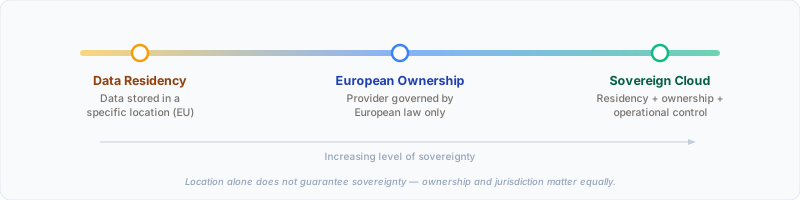
That distinction matters in provider selection because location alone does not show who controls the service, who can access it, or which legal framework governs it. In practice, some providers position sovereignty as a geographic label, while others treat it as an operational commitment, full control over the stack, no opaque dependencies, and the ability to audit every layer. For a deeper analysis, see our article on the CLOUD Act vs GDPR and our guide to data sovereignty.
Why companies choose a European cloud provider
For many companies, the decision concerns more than infrastructure location. It affects which legal framework applies, who can access systems and data, and how strongly the organization depends on a provider’s platform, pricing model, and surrounding ecosystem. Common reasons for choosing a (sovereign) European cloud hosting provider include:
- Sovereignty: Reduced exposure to foreign control and access laws
- GDPR compliance: European providers are natively aligned with GDPR, reducing the legal complexity of international data transfers and exposure to the US CLOUD Act
- European jurisdiction: Ownership and operational control may align more closely with European legal structures than with non-European hyperscalers
- Trust and procurement fit: Often relevant for regulated industries and the public sector
- Less ecosystem dependency: Reduced reliance on non-European hyperscaler platforms
- Operational clarity: Providers that master their own stack offer clearer responsibility boundaries, customers know exactly what is managed, what is not managed, and what decisions remain theirs
In practice, the choice is usually a combination of these factors. That is why the provider selection should not be based on region alone, but on who controls the service, which laws apply, and how well the provider fits the organization’s operational priorities.
Key factors to evaluate before choosing a provider
For some organizations, sovereignty and compliance are the main filters. For others, the deciding factors are managed services, cost structure, or support quality. A helpful European cloud provider comparison should focus on the criteria that will matter in the whole work process.
1. Sovereignty and jurisdiction
Review who owns the provider, where it operates, and which laws may apply. Data stored in Europe does not automatically mean full sovereignty if control or legal obligations still sit outside Europe.
2. Compliance and certifications
Check whether the provider supports your regulatory requirements with the relevant certifications, auditability, access controls, and security processes. This is especially important in regulated industries and public sector environments.
3. Platform capabilities and managed services
Assess whether the platform can support your workloads in practice. Compare the core infrastructure and the managed services your team needs, such as Kubernetes, databases, object storage, or automation features. Also consider portability: does the provider rely on open standards (Kubernetes, S3-compatible storage, standard APIs) or proprietary services that increase switching costs? Finally, check whether the platform is fully self-service, some European providers require a sales conversation or corporate contract before you can deploy anything.
4. Pricing transparency and total cost
Do not focus on entry-level pricing alone. Review billing logic, data transfer charges, support costs, and how easy it is to estimate overall spend before deployment.
5. Regional footprint and workload fit
Compare the provider’s data center footprint with your latency, resilience, and coverage requirements. The right choice depends on whether the platform fits the workloads and regions you actually need to support.
Top 10 European Cloud Providers in Comparison (2026)
Our comparison assesses the key selection factors introduced above for each provider. The following providers represent the most relevant European cloud platforms as of 2026:
1. Exoscale 
Exoscale is a European cloud provider headquartered in Switzerland, focused on core infrastructure and cloud-native platform services for modern application workloads. It is fully European-owned and maintains control over its core infrastructure stack, from hardware to platform services.
Key features:
- Data centers in Switzerland, Austria, Germany, Bulgaria, and Croatia (5 countries, 8 zones)
- Core portfolio across compute, AI, object and block storage, managed Kubernetes, managed databases (PostgreSQL, MySQL, OpenSearch, and more), networking, and GPU services
- Strong control over the core infrastructure stack, with European partners where needed
- Developer-friendly experience with full API, CLI, and Terraform support
- Direct access to engineering teams, support is handled by the people who build and operate the platform, not outsourced help desks
- Fully self-service, sign up, deploy, and scale without going through a sales process
- Per-product SLAs, not a single blanket SLA or no SLA at all
- Built on open standards (Kubernetes, S3-compatible storage) to preserve workload portability
Pricing: Pay-as-you-go
Limitations:
- More focused service portfolio compared to hyperscalers, prioritizing core infrastructure and cloud-native capabilities over a broad range of proprietary services
- Not designed for organizations relying on highly specialized, proprietary enterprise services or tightly integrated hyperscaler ecosystems
Best fit: Exoscale is best suited to teams running cloud-native applications that need straightforward European infrastructure with strong Kubernetes support.
2. OVHcloud 
Headquartered in France, OVHcloud is one of the largest cloud and infrastructure providers in Europe, with a broad portfolio and an established international footprint.
Key features:
- Data centers across Europe, North America, and Asia-Pacific
- Broad portfolio across compute, storage, networking, databases, AI, and bare metal
- Built-in DDoS protection
- Unlimited free egress
Pricing: Pay-as-you-go
Limitations:
- Limited managed services
- Platform complexity can require more manual configuration and operational expertise
- Smaller integration and partner ecosystem
Best fit: OVHcloud is best suited to organizations that need broad infrastructure options, strong European positioning, and wider regional coverage.
3. Scaleway 
Also based in France, Scaleway offers a broad cloud platform with a mix of infrastructure services and more flexible deployment options.
Key features:
- Data centers in France, the Netherlands, Poland and Italy
- Broad portfolio across compute, bare metal, Kubernetes, AI, storage, databases, and serverless services
- User-friendly dashboard
Pricing: Pay-as-you-go
Limitations:
- Less suited to multi-region deployments
- Inconsistent support
- Smaller ecosystem
Best fit: Scaleway is best suited to teams that want a broad service range and flexible infrastructure options within a European cloud environment.
4. IONOS 
IONOS, based in Germany, combines cloud infrastructure with a more enterprise-oriented platform model.
Key features:
- Data centers in Germany, Spain, France, the United Kingdom, and the United States
- Core portfolio across compute, storage, Kubernetes, databases, AI, and networking
- Both HDD and SSD storage options
- Cloud Designer with drag-and-drop configuration
Pricing: Pay-as-you-go
Limitations:
- Complex pricing model with extra fees for bandwidth and some services
- Egress traffic is charged
- More enterprise-focused and less developer-friendly
Best fit: IONOS is best suited to organizations that want enterprise-oriented infrastructure with broad regional coverage and flexible storage options.
5. T Cloud Public 
T Cloud Public (formerly Open Telekom Cloud) is the cloud platform of Deutsche Telekom, based in Germany and geared primarily toward enterprise and public-sector environments with a strong focus on sovereignty and managed services.
Key features:
- Data centers in Germany and the Netherlands
- Core portfolio across compute, storage, containers, networking, security, and managed services
- Hybrid cloud integration with on-premises environments
- Enterprise-backed stability
Pricing: Pay-as-you-go or reserved pricing
Limitations:
- Higher pricing
- Fewer international region options
- More complex for smaller teams
Best fit: T Cloud Public is best suited to regulated and enterprise environments with stricter operational and compliance requirements.
6. STACKIT 
STACKIT, developed within the Schwarz Group in Germany, is designed primarily as an enterprise cloud offering with a strong regional focus in the DACH market.
Key features:
- Data centers in Germany and Austria
- Core portfolio across compute, storage, Kubernetes, databases, networking, and security
- Designed for enterprise and regulated environments with a strong DACH focus
Pricing: Pay-as-you-go
Limitations:
- Only available for companies; no private or test use
- Less mature self-service experience compared to developer-focused cloud platforms
- More limited service portfolio and regional footprint compared to broader European providers
Best fit: STACKIT is best suited to companies in the DACH region that want an enterprise-focused cloud platform with a strong regional orientation.
7. UpCloud 
The Finnish cloud provider UpCloud is focused on high-performance infrastructure for modern workloads.
Key features:
- Data centers in Europe, Asia, Australia, and North America
- Core portfolio across compute, storage, networking, and managed cloud services
- High-performance MaxIOPS block storage
- Developer-friendly cloud platform
Pricing: Fixed hourly pricing
Limitations:
- A proprietary storage model may increase lock-in risk
- No specific AI offering, such as inference
- Smaller ecosystem and service breadth compared to larger European providers
Best fit: UpCloud is best suited to teams that prioritize infrastructure performance and broader location options within a European provider context.
8. Infomaniak 
Operating out of Switzerland, Cloud Provider Infomaniak combines cloud infrastructure with a strong focus on privacy and sustainability.
Key features:
- Data centers in Switzerland
- Core portfolio across public cloud, storage, backup, AI and collaboration services
- GDPR and nFADP compliance focus
Pricing: Pay-as-you-go
Limitations:
- Data centers are limited to a single country
- Limited managed services
- Smaller feature set than broader cloud platforms
Best fit: Infomaniak is best suited to organizations that prioritize Swiss sovereignty, cost efficiency, and a simpler regional cloud setup.
9. Hetzner 
Hetzner, founded in Germany, is known for a low-cost infrastructure offering with a straightforward service model and broad appeal among developers and smaller teams.
Key features:
- Data centers in Germany, Finland, the United States, and Singapore
- Core portfolio across cloud servers, dedicated servers, storage, and networking
- Built-in DDoS protection
Pricing: Pay-as-you-go
Limitations:
- Primarily infrastructure-focused, with a smaller portfolio of managed and platform services
- Basic support model
- Fewer built-in tools for complex cloud-native or large-scale enterprise workloads
Best fit: Hetzner is best suited to cost-conscious teams that want simple infrastructure services without a broad managed platform.
10. Aruba Cloud 
Headquartered in Italy, Cloud Provider Aruba Cloud offers a broad cloud infrastructure portfolio.
Key features:
- Data centers in Italy, the Czech Republic, France, Germany, Poland, and the United Kingdom
- Core portfolio across public cloud, VMware cloud, storage, and private or hybrid cloud solutions
- Data protection focus
Pricing: Pay-as-you-go
Limitations:
- More limited managed and platform services
- More limited international coverage
Best fit: Aruba Cloud is best suited to organizations that want a European provider with broad infrastructure coverage, including VMware and hybrid cloud use cases.
Comparison Table of European Cloud Providers
The table below provides a quick overview of the most relevant differences in provider selection.
| Provider | HQ | Differentiator | Access & pricing | Best for |
|---|---|---|---|---|
| Exoscale | Switzerland | Cloud-native platform with managed Kubernetes, databases and AI | Self-service, pay-as-you-go | Cloud-native and Kubernetes-based workloads |
| OVHcloud | France | Largest European footprint with free egress and DDoS protection | Self-service, pay-as-you-go | Broad infrastructure at scale |
| Scaleway | France | Broad platform with AI, serverless, and bare metal | Self-service, pay-as-you-go | Developer and AI teams |
| IONOS | Germany | Enterprise platform with flexible storage and Cloud Designer | Self-service, pay-as-you-go | Enterprise workloads with regional coverage |
| T Cloud Public | Germany | Regulated environments with hybrid cloud integration | Sales-assisted, pay-as-you-go / reserved | Public sector and regulated enterprise |
| STACKIT | Germany | Sovereign DACH-focused enterprise cloud | Companies only, pay-as-you-go | DACH enterprise compliance |
| UpCloud | Finland | High-performance MaxIOPS block storage | Self-service, fixed hourly | Performance-critical I/O workloads |
| Infomaniak | Switzerland | Swiss sovereignty with sustainability focus | Self-service, pay-as-you-go | Swiss-focused privacy-first deployments |
| Hetzner | Germany | Lowest-cost infrastructure with simple pricing | Self-service, pay-as-you-go | Cost-conscious developers and startups |
| Aruba Cloud | Italy | Broad Southern/Central European coverage with VMware support | Self-service, pay-as-you-go | Hybrid cloud in Southern Europe |
Choosing the Right European Cloud Provider
There is no universally best European cloud provider. The right choice depends on matching your specific requirements to provider strengths:
- For cloud-native Kubernetes workloads: Exoscale offers managed Kubernetes, managed databases, and transparent pricing with full European sovereignty.
- For broad infrastructure at scale: OVHcloud provides the widest service range and the largest European data center footprint.
- For regulated and public-sector environments: T Cloud Public and STACKIT provide the compliance certifications and enterprise support these use cases require.
- For cost-sensitive, self-managed infrastructure: Hetzner offers the most competitive pricing in Europe.
- For Swiss data sovereignty: Exoscale and Infomaniak both operate from Switzerland under Swiss law.
Before committing, run a proof-of-concept with your actual workloads. Evaluate not just pricing and features, but support quality, documentation, and day-to-day operational experience on the platform.
A final consideration: the best provider is not necessarily the one with the longest feature list. For organizations running production workloads where reliability, transparency, and control matter more than breadth, the right choice is a provider that assumes full responsibility for its stack and makes it easy to leave if needed.
Frequently Asked Questions about European Cloud Providers
What is the best European cloud provider for Kubernetes?
Exoscale offers managed Kubernetes (SKS) integrated with managed databases and S3-compatible object storage across multiple European zones. OVHcloud and Scaleway also provide managed Kubernetes, but Exoscale’s platform is specifically designed around cloud-native workflows with simpler day-to-day operations.
Are European cloud providers GDPR compliant?
GDPR applies to any organization that processes the personal data of EU residents, regardless of where the organization is based. A cloud provider does not need to be European to comply with GDPR. That said, European-headquartered providers are natively subject to EU law, which can simplify compliance and reduce legal friction. The key practical difference is that European providers are not exposed to foreign data access laws like the US CLOUD Act, which can conflict with GDPR obligations. All ten providers in this comparison are European-owned. See our detailed analysis of CLOUD Act vs GDPR.
Which European cloud provider is cheapest?
Hetzner remains one of the most cost-effective providers for compute and storage in Europe, particularly for self-managed infrastructure. However, recent price adjustments and varying pricing models across providers mean it is no longer consistently the cheapest in all scenarios. When factoring in managed services such as Kubernetes, databases, and support, providers like Exoscale can offer a lower total cost of ownership for teams that prefer not to manage every layer of their stack.
What is the difference between data residency and data sovereignty?
Data residency means your data is stored in a specific location, such as the EU. Data sovereignty goes further: it means the provider is owned and operated by European entities, under European law, with no foreign jurisdiction that could compel data access. For a full explanation, read our guide to data sovereignty.
What are the best European alternatives to AWS?
The most relevant European alternatives to AWS in 2026 include Exoscale (cloud-native Kubernetes, developer-focused infrastructure, AI), OVHcloud (broad infrastructure at scale), Scaleway (AI, bare metal, and flexible platform services), and Hetzner (cost-efficient infrastructure).
All are European-headquartered providers offering European data center options and designed to support GDPR-aligned deployments. However, sovereignty and jurisdictional exposure should be evaluated based on each provider’s ownership, operational model, and service configuration.
The right choice depends on whether you prioritize managed services, pricing, or sovereignty.
Can European cloud providers replace AWS, Azure, or Google Cloud?
For many workloads, yes. European cloud providers offer compute, storage, Kubernetes, databases, and networking that cover the core infrastructure needs of most applications. The gap is typically in proprietary managed services like AWS Lambda or Google BigQuery. Organizations using open standards and cloud-native tools can migrate to European providers with limited friction.
Which European cloud providers offer GPU instances?
As of 2026, Exoscale, OVHcloud, Scaleway, IONOS, and STACKIT offer GPU instances for AI, machine learning, and high-performance computing workloads. Availability and maturity varies — some providers focus on raw GPU access while others offer more integrated AI and inference capabilities.