AI agent architecture: How modern AI agents are designed
AI agents are moving from simple response generation toward more active roles in digital workflows. Organizations increasingly use them to coordinate tasks and act across connected systems. But without a clear architecture, teams struggle to control, monitor, and trust autonomous behavior. This article explains the components that make up an AI agent architecture, and the reasons why design choices matter in the long run.
Quick summary of this article
- The AI agent architecture defines how an agent receives information, makes decisions, uses tools, and produces actions.
- Modern AI agents work through a decision cycle that helps them respond to context, results, and feedback.
- Common architecture patterns include single-agent, multi-agent, reactive, deliberative, and hybrid approaches.
- Memory and tool access allow AI agents to use relevant context and interact with real systems.
- Key challenges include governance, security, observability, and reliable control over autonomous behavior.
What is an AI agent architecture?
Put simply, an AI agent architecture defines the structure and behavior of an AI agent, acting as the blueprint for how information flows and components interact. It describes how the agent receives information, interprets an objective, makes decisions, and produces an output or action. The language model (LLM) is one component inside that architecture.
The architecture extends beyond the AI model during the process. The model contributes reasoning, but the wider system defines how context, tool access, control mechanisms, and feedback work together. As a result, the architecture strongly influences how autonomous, reliable, transparent, and adaptable an AI agent can be.
From chatbots to agentic systems: The evolution of LLM agent architecture
AI agents did not develop in a clean year-by-year sequence. Instead, several capabilities evolved in parallel and later converged into what many teams now call agentic systems.
- Retrieval-augmented generation, or RAG, has existed since 2020. RAG connects a generative model with external information retrieval, so the system can use relevant source material before producing an answer. This later became an important foundation for retrieval-based assistants. With that approach, the agent receives information from sources and injects it into the context so the LLM can use it.
- Reasoning-and-action patterns became visible before the current wave of production agents. One important example is ReAct, a 2022 approach that combines reasoning steps with actions and allows a model to interact with external sources or environments while working toward a result.
- Chatbots made conversational LLMs widely visible after ChatGPT launched in late 2022. These systems mainly respond to user input. They can generate text, answer questions, and support simple conversations, but they do not necessarily plan or act beyond the current exchange.
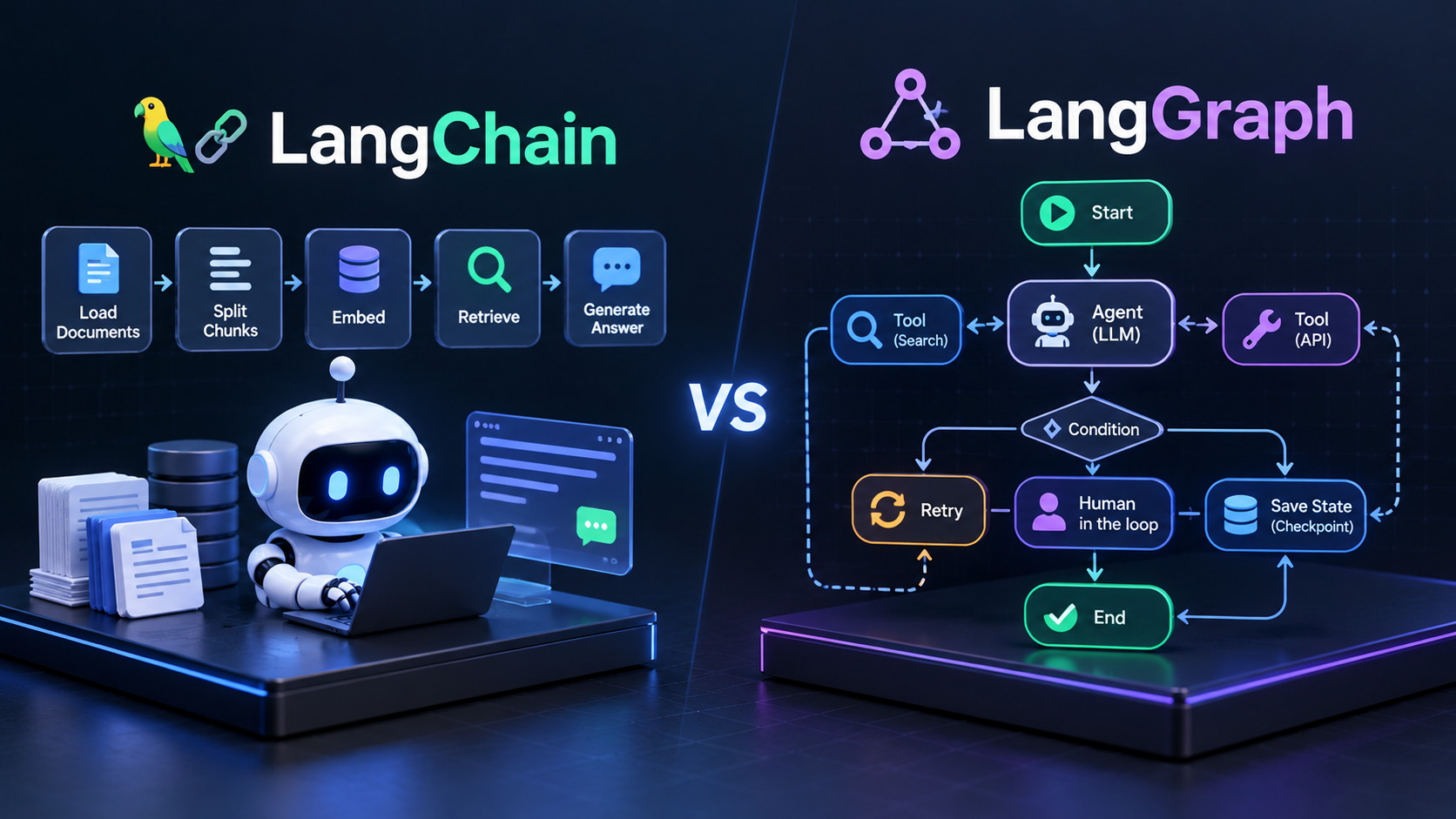
- Development frameworks, also released around late 2022, made it easier to combine models, retrieval, memory, tools, and workflow logic in practical applications. LangChain became one of the early influential frameworks for connecting language models with tools, data sources, memory, and workflow logic. Later frameworks and SDKs (Software Development Kits), including LangGraph, LlamaIndex, AutoGen, Semantic Kernel, CrewAI, and the OpenAI Agents SDK, added more possibilities for multi-agent coordination, graph-based orchestration, and production-oriented agent workflows. This helped move LLM systems from isolated responses toward more structured agent workflows.
- Agentic systems combine several of these building blocks in one workflow. They may use retrieval, tools, memory, planning, orchestration, and feedback. The term became more common in mainstream enterprise discussions around 2023/2024, but the underlying capabilities had already been developing for years.
Differentiating between autonomous and non-autonomous AI agents
Agentic systems differ in how much independence their architecture gives them during a workflow. Some agents only support individual steps inside a guided process. Others can evaluate results, choose follow-up actions, and continue until a defined stopping point. This is the basic distinction between non-autonomous and autonomous AI agents.
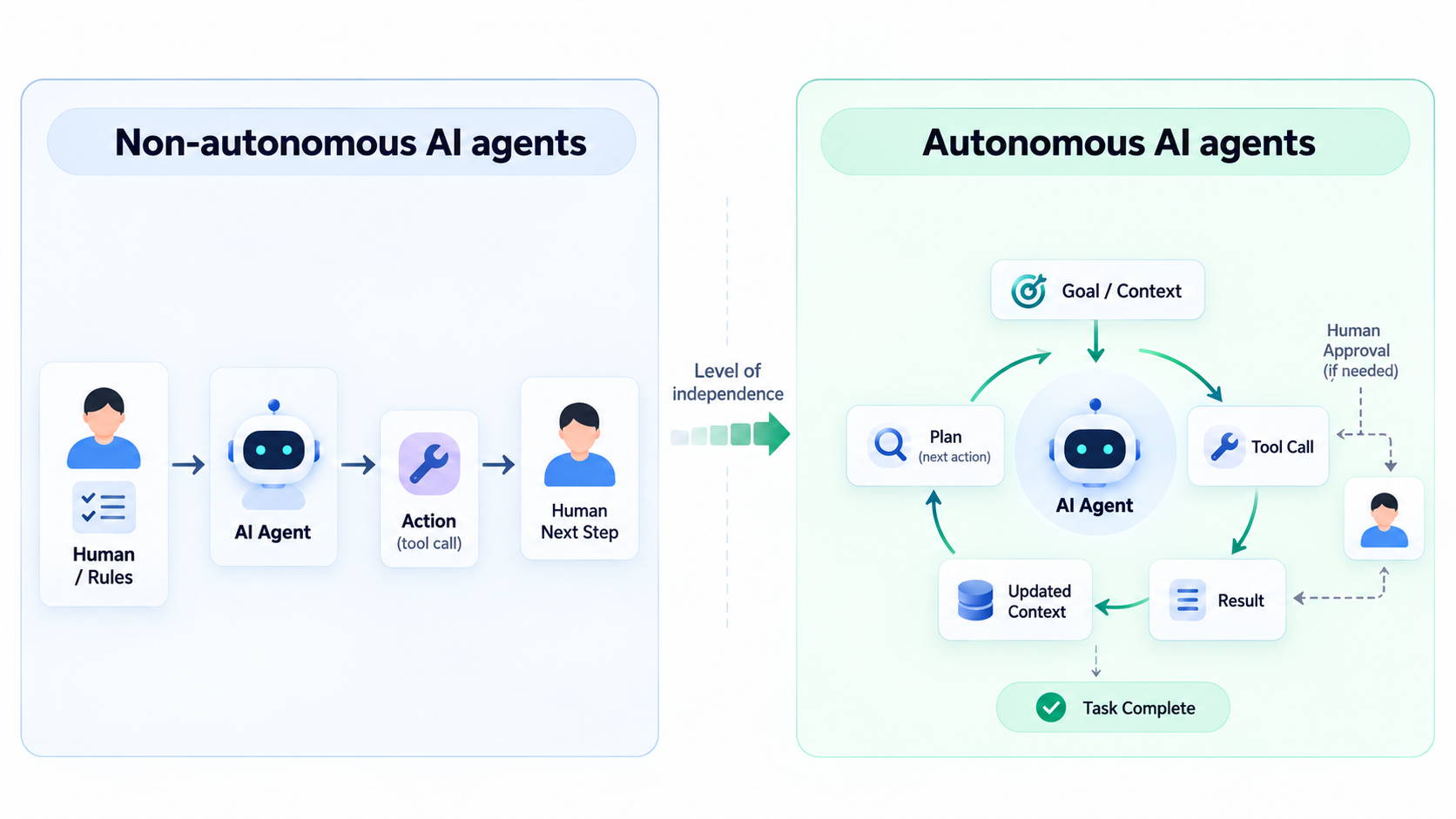
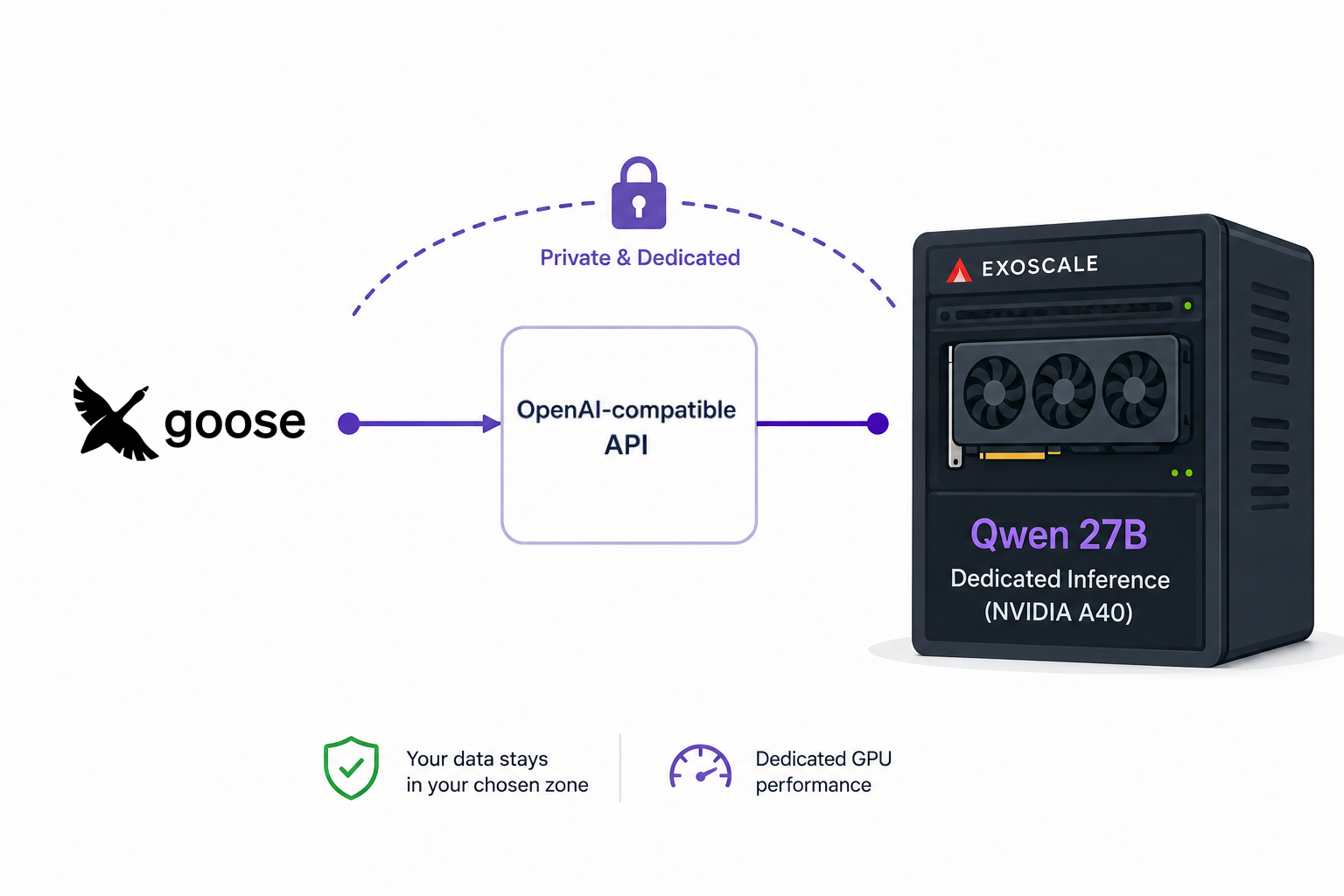
- Non-autonomous AI agents: These agents operate within predefined steps, rules, or human-guided workflows. They may answer a prompt, retrieve information, suggest an action, or call a tool once, but they do not independently manage the full task. Humans or fixed process logic define the next step, which makes their behavior more predictable. Tool examples include Goose and Claude Code.
- Autonomous AI agents: They can interpret a goal, use context, select actions, call tools, evaluate results, and adjust the next step, with minimal or no human help. OpenClaw and Hermes are two examples of autonomous AI agents. In LLM-based systems, this often happens through a repeated loop: the model receives context, returns tool-call instructions, the system executes the tool, adds the result back to the context, and asks the model for the next step. The loop continues until the task is complete, no further tool call is needed, an error occurs, or a human approval point stops the process.
The more an AI agent architecture can manage goals, plan actions, adapt to results, and continue without step-by-step human direction, the more autonomous it becomes.
Core components of AI agents
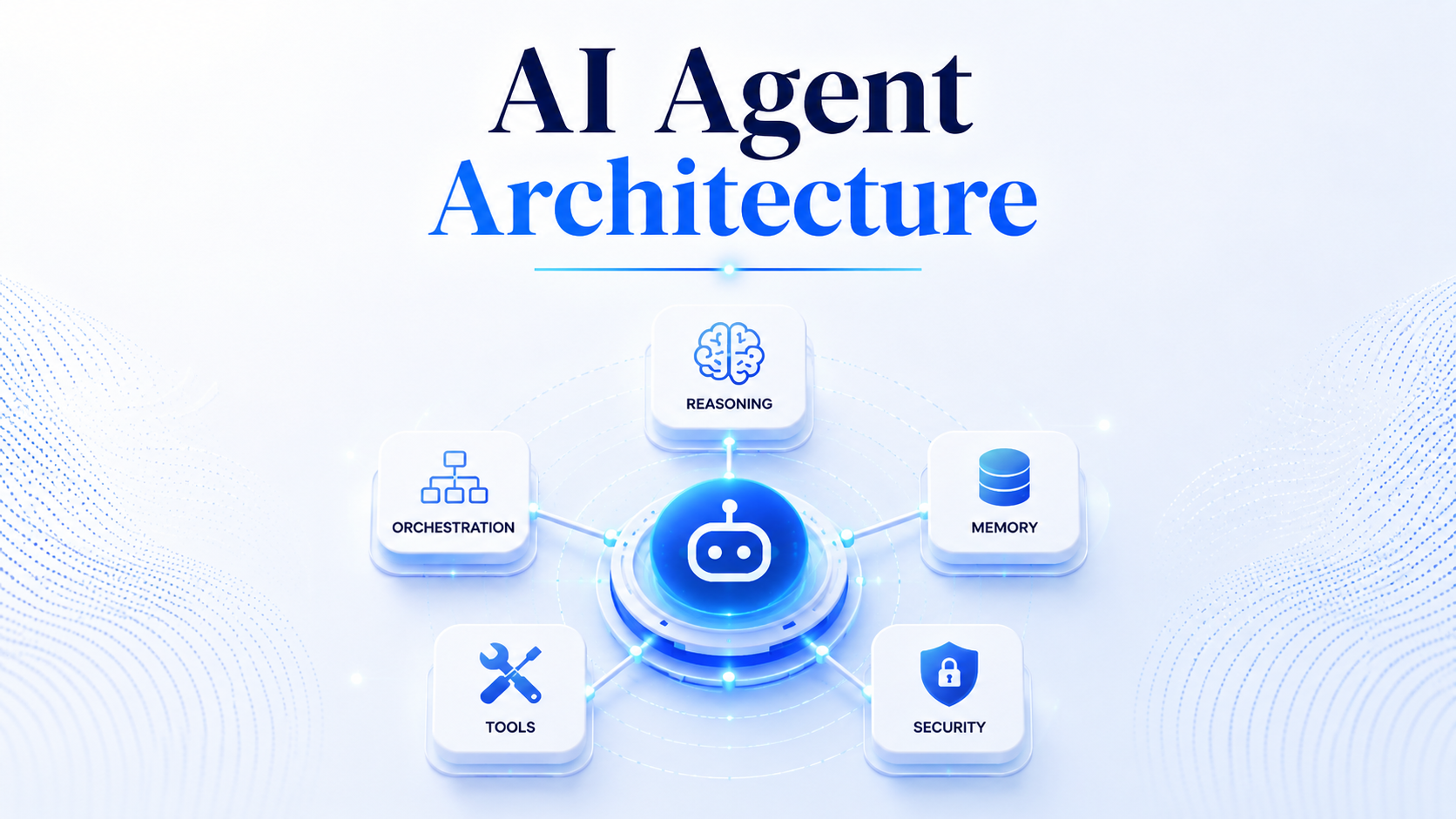
The architecture of an AI agent contains several connected components. The language model represents just one architectural layer, whereas the surrounding components determine the available information, permitted actions, and workflow structure.
| AI agent component | Role in the AI agent architecture |
|---|---|
| Model or reasoning engine | Interprets language, understands the task, supports decision-making, generates responses or structured outputs, and returns the tools that the agent needs to execute |
| Perception and data ingestion | Brings information into the system from users, documents, applications, databases, logs, sensors, APIs, or other external sources |
| Planning and task decomposition | The underlying LLM breaks larger goals into smaller steps and helps define a workable path toward the task outcome |
| Action execution | The LLM selects the tools, enabling the agent to perform selected actions, such as triggering workflows, updating records, sending requests, or producing structured outputs |
| Orchestration | Coordinates components, tools, and workflow steps so the system can operate in an organized way |
| Feedback and reflection | Supports outcome evaluation, error correction, retry logic, and improvement during a task |
How AI agents work: The agent decision cycle
Within an AI agent architecture, a task moves through several steps from the moment it is received until it is complete. Each step’s outcome can affect the next, setting agent workflows apart from fixed automation.
- Receive task and context: The process starts with a task and the information needed to work on it. This may include a user request, documents, prior conversation history, system data, tool results, or predefined constraints.
- Ask the LLM what to do next: The system sends the current context to the language model. The model evaluates the task state and decides whether to answer, ask for more information, ask the AI agent to call a tool on its behalf, or take another available step.
- Execute the selected action: If the model returns tool-call instructions, the system executes the action. This may involve retrieving information, updating a record, triggering a workflow, generating an output, or sending a request.
- Add the result to the context: The action result becomes part of the task context. This gives the model new information for the next decision.
- Repeat or stop: The system sends the updated context back to the model. The loop continues until the task is completed, no more tools are needed, a stopping condition is reached, or a human must approve the next step.
Major LLM agent architecture patterns
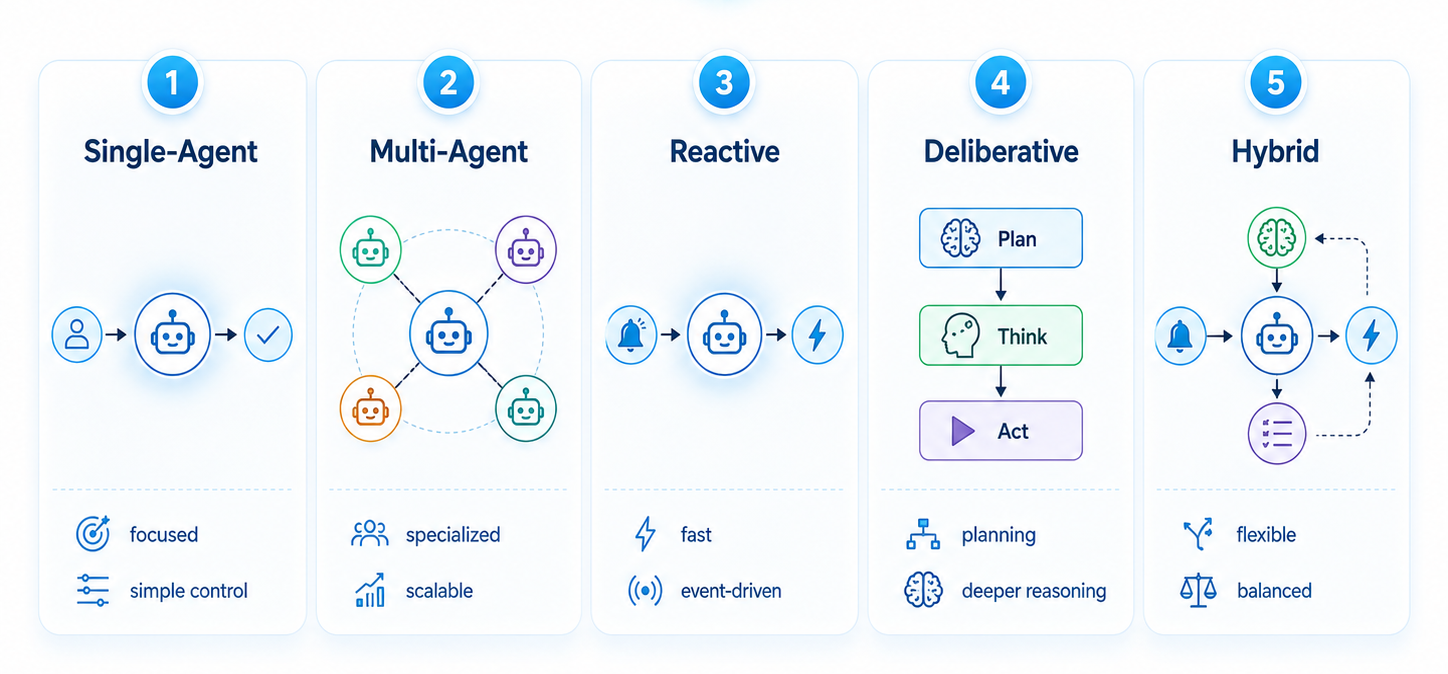
Firstly, architectural patterns for AI agents demonstrate various ways of organising agent workflows and decision paths. They also clarify how a system distributes work and balances speed, reasoning depth, reliability, and oversight. The appropriate pattern depends on the complexity of the task, the level of autonomy required, the latency, the governance, the depth of integration, and the reliability needs.
Single-agent architectures
In a single-agent setup, the workflow is assigned to one agent from start to finish. The agent receives information, interprets the task, selects the next step, and executes actions through available tools. This pattern is most effective for focused and bounded use cases, as it makes the decision path easier to design, test, monitor, and control.
A popular example is the AI agent Goose. It can handle a task through a single agent instance. Furthermore, MCP (Model Context Protocol) can connect the agent to external tools and data sources, while AGENTS.md can provide project-specific instructions that guide its work. However, Goose also supports subagent delegation, so its architecture can extend to multi-agent workflows.
Multi-agent architectures
In multi-agent systems, several specialized agents share responsibility for a larger task. Each agent may focus on a specific role, such as analysis, validation, coordination, or execution. The agents can work together directly or operate under an orchestration layer. This improves specialization and scalability, but it also increases coordination effort, testing complexity, security requirements, and observability needs.
Goose supports workflows in which a main agent delegates tasks to independent subagents. The Agent2Agent (A2A) protocol provides another relevant building block by enabling agents across different platforms and frameworks to exchange tasks and information.
Reactive architectures
Reactive designs prioritize immediate responses to inputs, events, or environmental changes. The agent does not rely on extended planning before every action. This makes the pattern useful when speed and predictability matter most, such as in monitoring, alerts, routing, or anomaly detection.
Infrastructure such as MCP and agentgateway can provide access to the tools and services these agents need, but the agent’s decision logic drives the reactive behavior.
Deliberative architectures
Deliberative systems prioritise reasoning and planning before action. The agent evaluates the objective, considers possible steps, and then selects a path forward. This pattern works well for complex, multi-step, open-ended, or high-stakes tasks where decision quality matters more than speed. The trade-off is higher latency and greater resource use.
Hybrid architectures
Hybrid designs combine reactive responses with deliberative reasoning. The system can respond quickly when a task is simple and use deeper planning when a task requires more careful decision-making. This makes the pattern practical for production-grade AI agents that need both speed and reasoning depth. Its main requirement is a clear structure, so the system remains testable, observable, and maintainable.
Infrastructure such as agentgateway and Agent Router can support connectivity, routing, and traffic management in these systems without determining their decision-making approach. Goose’s tool use and optional subagent delegation could support parts of such a workflow, although Goose is not inherently limited to this architecture.
Context and tool access in LLM agent architectures
For an AI agent, its architecture must also provide relevant context and controlled access to external systems and the tools that it can use. Context is the information the model needs for the current step of work. That can include the current task, recent interaction history, relevant user data, and retrieved business knowledge.
- Memory supports the context layer: Memory is information stored outside the current prompt (e.g., a database or session store) that can be retrieved and added when it’s relevant. It helps the agent track the current task, previous interactions, user preferences, and important organizational knowledge. Since context windows are limited, not every detail should be stored or added to every prompt. The architecture should retrieve information only when the task requires it.
- Tools turn context into action: Tools let the agent interact with external systems in a controlled way. Depending on the architecture, that can mean searching the web, reading files, querying databases, calling internal APIs, updating records, or triggering workflow steps. The model does not automatically have access to these tools. One approach for standardizing these connections is the Model Context Protocol (MCP). It provides a structured way for AI systems to connect with external tools and data sources. Instead of creating separate integrations for each system, MCP allows agents to discover available capabilities and exchange information through a common interface.
Because memory and tools can affect sensitive data and real processes, they need clear controls. Without safeguards, the agent may rely on outdated context, expose sensitive data, choose the wrong tool, or trigger unintended actions.
Governance, security, and observability of AI agent architectures
As AI agents gain more autonomy, they need clear limits. These limits define what the agent may access, which actions it may take, and how teams review its behavior after task completion. Without proper safeguards in place, teams may find it difficult to monitor decisions, correct errors, or have faith in the system when working on live projects.
The most important controls can be organised into three categories.
- Governance: Defines what the agent is allowed to know, decide, and do. It includes permissions, approval rules, escalation paths, audit logs, and accountability for agent actions. Tools such as agentgateway and Agent Router help enforce access policies and manage agent connections. AGENTS.md provides a standard format for documenting instructions for coding agents, but does not enforce permissions.
- Security: Protects connected data and systems. The control includes access restrictions, input validation, output checks, and safeguards against data exposure or prompt-based attacks. Agentgateway provides secure access to tools and APIs, while Agent Router supports authentication and usage limits.
- Observability: Makes agent behavior traceable. In order to understand how the system behaves in practice, teams need to review decisions, tool calls, context, errors, latency, and costs. Agentgateway supports logging, metrics, and tracing, while Agent Router helps track and manage model usage.
These controls are especially important for high-risk actions. Deleting data, changing important records, contacting customers, or making compliance-sensitive decisions should usually require human approval. Teams also need clear stopping conditions, so the agent does not continue a task indefinitely.
Implementation paths and practical guidelines
Teams can implement LLM agent architectures in different ways, depending on the use case, technical requirements, and available expertise.
| Implementation Option | Suitable For | Main Consideration | Examples |
|---|---|---|---|
| Custom Engineering | Complex or highly specific production systems that need full control over logic, integrations, security, and deployment | Requires strong technical expertise and higher implementation effort | Fully custom agent systems built in-house |
| Agent Development Frameworks | Structured workflows involving planning, memory, tool use, orchestration, or multi-agent coordination | Requires careful review of security, observability, and maintainability | LangChain, LangGraph, LlamaIndex, AutoGen, Semantic Kernel |
| Low-Code or No-Code Platforms | Standardised workflows that need faster implementation with less custom development | May limit flexibility, customization, and portability | n8n, Flowise, Langflow |
| Platform-Native Agents | Workflows that mainly operate inside an existing software environment | Can simplify adoption, but may create dependency on one ecosystem | OpenAI Agents SDK, Microsoft Copilot Studio, Google Vertex AI Agent Builder |
A reliable implementation usually starts with a narrow use case that has a clear goal and measurable outcomes. If a deterministic workflow or simple automation can solve the problem more predictably and with less overhead, teams should not default to an agent-based system.
When an agent is the right choice, the architecture should stay modular. Reasoning, memory, tool access, execution, and governance should remain clearly separated so teams can test, monitor, and adjust each part without destabilizing the whole system.
LLM agent architecture for reliable autonomy
The next generation of AI agents will be judged less on how autonomous they appear and more on how reliably their autonomy can be governed. As these agents become integrated into real business workflows, their architectures will require stronger memory design, safer tool access, clearer governance, and improved decision traceability. Many systems will also combine language models with retrieval, orchestration, monitoring, and other specialised models to enable more reliable execution.
This becomes even more important in multi-agent environments. In those settings, clear security models, approval steps, and ongoing evaluation will be essential for keeping systems safe, manageable, and easier to improve over time.
Ultimately, AI agents create value when a clear architecture supports their autonomy with the right controls. Reliable agent architectures need structured components, relevant context, controlled tool access, clear oversight, and defined limits. Organisations should apply autonomy where it creates measurable value and where they can manage it responsibly in production.
FAQ about AI agent architectures
What are AI agent architectures?
The architecture is basically the blueprint for how an AI agent behaves, from how the agent receives information and interprets the intent to making decisions and producing an output. While the AI model delivers the reasoning, the architecture defines the wider structure for context, tool access, planning, execution, feedback, and safety.
What are the main AI agent components?
The main components of LLM agent architectures usually include a reasoning model, data input, planning logic, action execution, orchestration, memory, and feedback. These parts work together so the agent can process information and complete tasks in a controlled way.
How do LLM agent architectures work?
An LLM agent’s architecture works by organizing the flow from input to decision and action. The system gathers information, evaluates context, selects a next step, executes an action, and checks the result before continuing or stopping.
What makes AI agent architectures reliable?
They use clear permissions, validated tool access, monitoring, fallback paths, and human approval for sensitive actions. These controls help keep the agent traceable, constrained, and safe to operate.
What is the difference between single-agent and multi-agent architectures?
A single-agent architecture uses one agent to handle the main workflow. A multi-agent architecture uses several specialized agents that work together or are coordinated by an orchestration layer, which can help with complex tasks but also adds more coordination effort.